

posted 8th June 2026
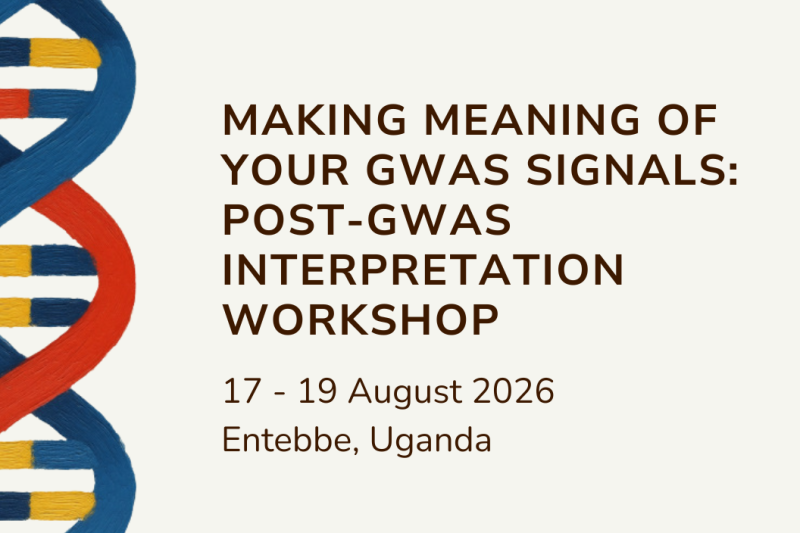
Making Meaning of Your GWAS Signals: Post-GWAS Interpretation Workshop
17-19 August 2026 | Entebbe, Uganda
Hosted by the NCD Genomics Group, MRC/UVRI & LSHTM Uganda Research Unit, and the Precision Healthcare University Research Institute (PHURI), Queen Mary University of London.
About the Workshop
Generating a genome-wide association study (GWAS) is one thing; making biological sense of the result is another. This three-day, fully in-person workshop is designed to support researchers in bridging this gap by developing practical skills in post-GWAS interpretation. The focus is on moving from association signals to biologically and clinically meaningful hypotheses through structured, hands-on analytical workflows.
This workshop places particular emphasis on interpretation in diverse genetic contexts, including African-ancestry populations, where differences in linkage disequilibrium structure and reference resources present both challenges and opportunities for discovery.
Why Attend?
This hands-on, applied training is designed to develop end-to-end competence in post-GWAS interpretation. By the end of the workshop, participants will be able to move from GWAS summary statistics to structured biological interpretation suitable for inclusion in manuscripts and downstream analyses.
Participants will gain practical experience in:
- Identifying and characterising associated loci
- Estimating SNP heritability and genetic correlation
- Performing statistical fine-mapping to refine causal signals
- Prioritising candidate genes through functional annotation
- Integrating multi-omics data for biological interpretation
- Writing structured post-GWAS results for publication
This workshop combines lectures with guided practical sessions and discussion-based learning. Participants will work with widely used post-GWAS tools and frameworks, including LDSC, SuSiE, FINEMAP, COLOC, SMR, MAGMA and related methods.
Who Should Apply?
We welcome applications from researchers at all career stages, including PhD students, postdoctoral researchers and early-career faculty.
This workshop is intended for researchers who:
- Have conducted and completed at least one GWAS
- Have access to GWAS summary statistics for downstream analysis
- Are proficient in R or Python and comfortable working in a Linux environment
- Are familiar with GWAS summary statistics and standard genomic data formats
- Are available to attend all three days in person
We particularly encourage applications from researchers working with African-ancestry cohorts and from institutions in low- and middle-income countries.
Practical Information
Format and Location
The workshop will be held fully in person in Entebbe, Uganda, from 17-19 August 2026. Remote participation will not be available.
Capacity
Places are limited and selection will be competitive.
Laptop and Software Requirements
Participants must bring their own laptop with:
- R (v4.3 or higher)
- Python (v3.9 or higher)
- Unix/Linux command-line access
A detailed setup guide will be provided to accepted participants before the workshop.
Travel and Accommodation
There is no registration fee for this workshop. However, participants are responsible for arranging and funding their own travel and accommodation in Entebbe, Uganda.
How to Apply
Applications must be submitted via the online application form:
https://forms.gle/RsK57ozdkGLUNsZD8
Applicants will be asked to provide:
- A letter of motivation (maximum 400 words) describing:
- their completed GWAS study
- the post-GWAS questions they would like to address
- the relevance of the workshop to their research trajectory
- A current CV in English (maximum 3 pages)
- A signed letter of support from their supervisor or head of department
Selection Process
Applications will be assessed based on:
- Demonstrated GWAS experience
- Clarity and motivation in the personal statement
- Alignment with post-GWAS analytical focus
- Diversity of background and career stage
Further Enquiries
For questions about the workshop or application process, please contact:
training@genomicdiversity.org
Workshop Information
Dates: 17-19 August 2026
Location: Entebbe, Uganda
Format: Fully in-person
Applications
Application Deadline: Friday, 26 June 2026
Outcome Notification: 10 July 2026
Important Notes
- There is no registration fee for this workshop. Participants are expected to cover their own travel and accommodation costs
- This workshop focuses on post-GWAS analysis and interpretation and is not intended as introductory training in GWAS
- Attendance is fully in person; remote participation is not available
Apply Here:
https://forms.gle/RsK57ozdkGLUNsZD8